
Blog
Nudges and their applications

Philosophy is a “theory or attitude that acts as a guiding principle for behaviour” (ODE, 2026). Fundamental guiding principles (and therefore philosophy) has a long history in economic thought. In the nineteenth century utilitarianism shaped the classical school of thought. Human well-being (i.e. welfare) and its philosophical foundations continue to influence economic thought and policy. Acknowledgement that people often don’t make optimal choices, raises the issue of how policy makers should respond.
Implicitly important to the notion of choice is personal autonomy. If providing people with choices is important, then such choices need to be autonomous – not under coercion. Preserving personal autonomy and agency in decision-making, while ensuring information is presented in clear, if leading, forms offers the prospect of balancing the desire of personal/socially optimal outcomes with personal choice.
Nudge Theory
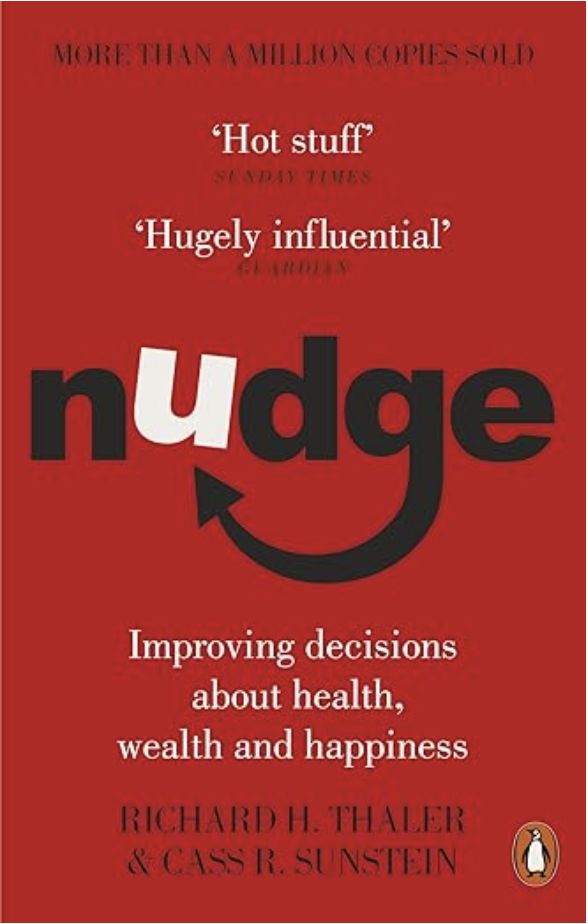
‘Nudge: improving decisions about Health, Wealth and Happiness’, the book by Richard Thaler and Cass Sunstein (2008), outlines the helpfulness of designed choice contexts to facilitate optimal choice. The facilitation of such choices relies on deliberately adjusting the presentation of information to promote individual and/or socially optimal decisions: choices that range from nutrition, long-term savings and registering to donate organs. The phrase – choice architecture – is used to summarise the design of decision contexts and information. The authors define a nudge as:
“…any aspect of the choice architecture that alters people’s behavior in a predictable way without forbidding any options or significantly changing their economic incentives. To count as a mere nudge, the intervention must be easy and cheap to avoid. Nudges are not mandates. Putting fruit at eye level counts as a nudge. Banning junk food does not” (emphasis added).
While nudges are the outcomes, choice architecture defines the techniques used to achieve the desired outcomes.
Components of nudge theory
The term ‘nudges’ is an acronym. Each letter standing for:

Figure 1: meaning of nudges and three central themes.
The link between nudges and behavioural economics is summarised by The Decision Lab (2025) in the following way.
“In the context of Nudges, choice architecture was said to minimize biases that result from bounded rationality. Limitations such as cognitive capabilities, the difficulty of the problem, and the time available to decide could be overcome if choice architects nudge humans toward beneficial choices” (The Decision Lab, 2025).
Nudge examples
This blog provides contemporary real-world applications for the three central themes of nudges (see Figure 1).
- Defaults
The US government is introducing cash transfers of US$1,000 to US children born between 1 January 2025 and 31 December 2028. The money is held in an investment account until the child reaches 18-years of age. The investment will be in an index fund (US government, 2025). These investment accounts are referred to ‘Trump accounts’ – see www.trumpaccounts.gov. The initiative will commence in July 2026. Private doners are also contributing to the cash transfers.
A private donation of US$ 6.25 billion will be made by Michael and Susan Dell. This money will be donated to children 10-years and younger who live in zip codes with median household incomes below $150,000. Approximately 25 million children will each receive $250 from the Dell’s. Employers can then contribute $2,500 per year to the accounts without the money being considered income (Kulish, 2025).
The Trump accounts are not automatically generated. Instead, parents will need to apply and enroll their children in order to receive the money. Behavioural economics (nudge theory) and empirical evidence tells us that not eligible children will receive the cash transfers due to the need for adults to manually enroll children.
Two US states have run large scale experiments demonstrating the effect of automatic vs manual enrolment in cash transfer programs (i.e. Child Development Accounts). In line with nudge theory, almost all children received cash payments when enrollment was automatic compared to only 40% when parents needed to manually enroll their children (Clancy and Sherraden, 2014; Huang et al., 2014).
“In the Oklahoma experiment, accounts were opened for a group of newborns in 2007. Enrollment was automatic unless parents opted out — which only one family did. But in Maine, where a philanthropist gave newborns $500 to invest for college if their parents opened accounts, just 40 percent did. (Maine has since switched to automatic enrollment, and participation is 100 percent.)” (Miller and Smith, 2025).
In addition to fewer children receiving the cash transfers, it is children from poorer households who are most likely not to be enrolled by their parents. As a consequence, there is an equity issue concerning the use of automatic vs manual enrollment of the Trump accounts.
- Structuring information
In a recent blog, I wrote about the allocative efficiency gains of using unconditional cash transfers (UCT) to poor households, compared to providing subsidies of the same value. Although UCT may be spent freely by household the presentation of information concerning the benefits of spending the money on children and their education and health ‘needs’ results in UCT being widely allocated to a range of child-benefiting options. Studies indicate that “child-focused framing” improve food security (Crosta et al., 2025) and investment in child development when unconditional cash transfers are given (Gennetian et al., 2024).
The use of framing helps to simplify complex choices that nudge recipients to spending UCT in particular ways without mandating it.
- Providing feedback
The emphasis on providing feedback to decision-makers and consumers implies that full and complete information is often missing from market decision-making. The structured provision of regular feedback of the outcomes of past decisions does positively impact current and future decisions. In a study evaluating the impact of energy usage information on subsequent demand, Jessoe and Rapson (2014) frame their argument around the importance of information to well-functioning markets.
“A key assumption underpinning central theorems in economics is that agents are fully informed. Yet information is rarely free to decision makers. Information costs may take many forms—time, cognitive effort, monetary expense, technological hurdles—and are pervasive in choice settings. A growing body of literature explores the importance of some of these information costs, demonstrating that decisions are dramatically altered when information is conveyed in a simple way” (Jessoe and Rapson, 2014, p. 1417; emphasis added).
Given the importance of information to improved decision-making, it is no surprise that ‘giving feedback’ makes its way into choice architecture and nudge theory. The quote above also highlights the importance of how information is presented. The simpler the presentation of information, ceteris paribus, the more accessible and useful the information.
The regular provision of household electricity usage, via smart metres and electricity bills are a common means of providing regular feedback. An example was provided in a recent blog. The research by Jessoe and Rapson (2014) establishes a causal link between the provision of electricity usage information and increase price elasticity of demand for household electricity.
“Electricity customers traditionally exhibit low price elasticity …, but this may be due to features of the setting that inhibit full information. Quantity consumed tends to be shrouded because of coarse and infrequent billing making it difficult to know both electricity usage at any moment in time and the input requirements of each appliance” (Jessoe and Rapson, 2014, p. 1418; emphasis added).
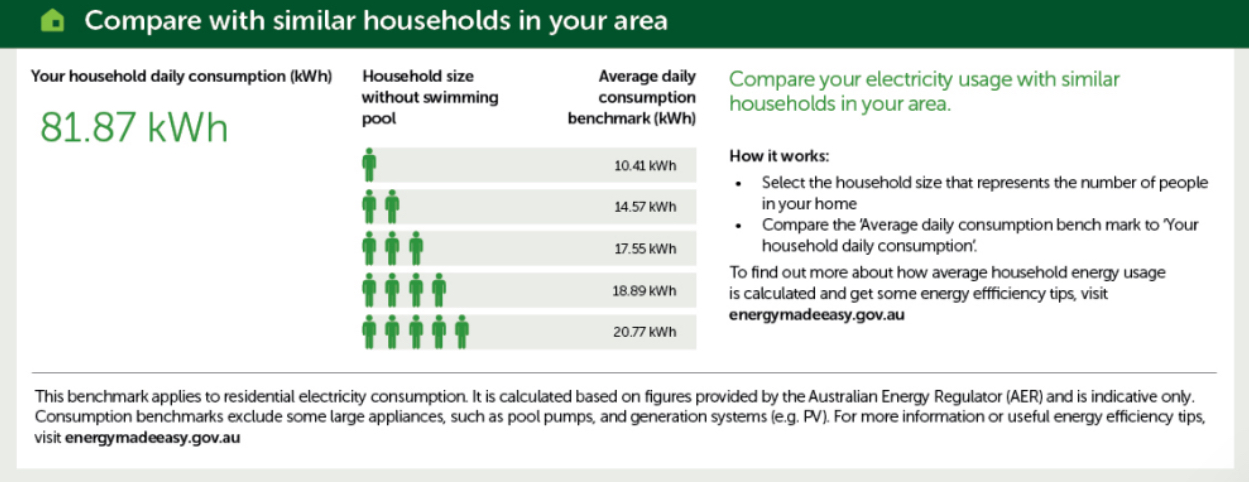
Figure 2: an example of simple electricity usage information with comparative benchmarks.
The application of nudge theory is widespread. Nudge theory is the collection of a series of behavioural economic principles related to ‘improving’ consumer/individual decision-making. The applications presented above help to:
- Predict the effect of not using default enrollment on the number and profile of children to receive cash payments (i.e. Trump Accounts).
- Demonstrate the effect of providing timely information to bring to mind private benefits of choices that also bring about socially desired outcomes.
- Underscore the importance of full and symmetric information to support informed decision-making.
References
Clancy, M. M., & Sherraden, M. (2014). Automatic deposits for all at birth: Maine’s Harold Alfond College Challenge. Link
Crosta, T., Karlan, D., Ong, F., Rüschenpöhler, J. and Udry, C.R. (2024). Unconditional Cash Transfers: A Bayesian Meta-Analysis of Randomized Evaluations in Low and Middle Income Countries. NBER Working Paper 32779 (2024), https://doi.org/10.3386/w32779. (Accessed: 10.12.2025)
Gennetian, L.A., Duncan, G.J., Fox, N.A. et al. (2024). Effects of a monthly unconditional cash transfer starting at birth on family investments among US families with low income. Nature Human Behaviour 8, 1514–1529 https://doi.org/10.1038/s41562-024-01915-7
Huang, J., Sherraden, M., Kim, Y., & Clancy, M. (2014). Effects of Child Development Accounts on early social-emotional development: An experimental test. JAMA pediatrics, 168(3), 265-271 http://doi:10.1001/jamapediatrics.2013.4643
Jessoe, K., & Rapson, D. (2014). Knowledge is (less) power: Experimental evidence from residential energy use. American Economic Review, 104(4), 1417-1438.
Kulish, N. (2025). Michael and Susan Dell put $250 in 25 million Children’s accounts. New York Times. 02.12.2025. https://www.nytimes.com/2025/12/02/business/dell-children-trump-accounts.html (accessed: 09.01.2026)
Miller, C.C. & Smith, J. (2025). Why Trump Accounts, as currently planned, Risk leaving out Many Children. The Upshot. New York Times. 09.12.2025. https://www.nytimes.com/2025/12/09/upshot/trump-accounts-dell.html (Accessed: 12.12.2025)
Oxford Dictionary of English (2026). Meaning of Philosophy.
Thaler, R.H. & Sunstein, C.R. (2008). Nudge: Improving Decisions about Health, Wealth and Happiness. Penguin.
The Decision Lab. (2025). Choice Architecture. https://thedecisionlab.com/reference-guide/psychology/choice-architecture (Accessed: 30.12.2025)