
Blog
Markets in pricing household electricity

The role of markets in pricing household electricity highlights the impact of market structure, strategic assets, and choice. Governments have a range of organisation options with respect to the operation of these electricity systems. How a government organises the production, distribution and purchasing of household electricity will determine the mix of efficiency in production and retailing of electricity and the ownership of strategic assets.
The key concepts of Choice, Intervention, Change and Interdependence (CICI) can be used to evaluate energy system organisation. Figure 1 places the CICI organizational key concepts into the wider context of the IB syllabus.

Figure 1: IB syllabus key concepts.
In analysing national electricity systems the following IB economics material may be considered:
- Natural monopoly
- Government regulation of pricing – price ceilings
- Competition and lowering of costs and elimination of abnormal (economic) profits
- Government intervention in pricing – subsidies
- Nudging consumer behavior – efficiency energy use
- Sustainability, net-zero and transitionary costs
Each of these components are addressed in this blog. References to ‘real-world’ examples from the Indonesian and Australian electricity markets are made as supporting evidence.
A simplified electricity system consists of generation, distribution, and household consumption. These three parts are depicted in Figure 2. Each part is considered separately.

Figure 2: components of the electricity system.
Part 1
A natural monopoly exists when a dominant firm has a declining Long Run Average Cost (LRAC) curve as its quantity produced increases. This downward sloping section of the LRAC is referred to as economics of scale. The quantity produced by the firm intersects with the downward sloping part of the LRAC. The more the firm produces its marginal costs (MC) rise. However, the firm’s fixed costs are so great that, despite rising MCs, the firm’s LRAC falls over the profit maximizing quantity. The relationship between economics of scale and natural monopolies is represented in Figure 3.

Figure 3: Natural monopoly in coal-fired electricity production.
Because of the natural monopoly feature of coal-fired energy production, governments choose to either produce electricity through a State-Owned Enterprise (SOE) or through a long-term contract with a private firm. In Indonesia, the government operates a SOE. In Australia, private firms operate these facilities. The private contract stipulates the price at which electricity is purchased by the government. This helps to lower the market price from PMON to P1MON (see Figure 3). Government intervention reduces or eliminates the profit margin otherwise exploited by the private firm.
After generation, the price of electricity is set (directly by the government in Indonesia – or via the contract in Australia). This price establishes a benchmark price at which household purchase electricity.
The Marginal Cost (MC) curve in panel (b) of Figure 3 is derived from the producer’s Total Cost (TC). Economic theory assumes that private firms establish their TC through a process of cost-minimisation. Either competition and the assumed profit-maximisation motivation drive the firm’s costs down. However, this assumed dynamic is highly questionable for a SOE, particularly one not facing competition.
Many governments are turning to non-fossil fuel sources of electricity generation. Alternative sourses include, non-centralised sources of renewable energy (solar, and wind), hydroelectricity through the construction of dams or nuclear energy. The political desire to secure sustainable energy gives rise to a current global period of energy transition. Governments and private firms are investing heavily in establishing secure sustainable energy sources at scale. For several reasons, this global transition to sustainable energy is financially costly. Centralised alternative energy production (nuclear and hydro) have high fixed costs. Many configurations of renewable energy (particularly solar) require significant infrastructure upgrades to facilitate large scale bi-directional energy movements (i.e. grid to household and household to grid).
Part 2
Governments worldwide frequently retain ownership of many parts of the infrastructure connecting parts 1 and 3 of the energy system. This infrastructure includes: high volume electricity transmission, electricity voltage reductions, and cabling to individual households. The management of this infrastructure may be provided directly by SOEs or contracted private firms.
Private firms, although assumed to operate at lower costs, are more likely to seek to pass on increases in costs to consumers. As sustainable energy investment increase, energy systems that incorporate private firms in the maintenance of part 2 are more like to have these increased costs passed directly onto consumers. By contrast, energy systems that are maintained by SOE will likely require increased government funding, which comes with increased opportunity costs and fiscal pressures.
In Indonesia, there are large areas of the country (country consists of 17,000 islands) that don’t have basic electricity infrastructure. Infrastructure that is taken for granted in Indonesia’s large urban areas. One of the limitations of the government managed energy system is that private investment is crowded-out. Private financial resources that could’ve been used to extend Indonesia’s electricity network are prevented. This will likely slow Indonesia’s economic growth and development.
Part 3
In the Indonesian and Australian energy markets, governments directly or through independent agencies, set prices (e.g. Indonesia) or benchmark prices (e.g. Australia). These may be forms of price ceiling. Governments may choose to subsidise these prices permanently or periodically for select residents or for all.
The retailing of electricity to households provides the greatest opportunity for competition. The Indonesian system has no private retailers. The Australian system has relatively strong competition in an oligopoly market structure. In Australia, retail prices are not directly regulated but the use of reference prices help households compare electricity prices through government run websites such as https://www.energymadeeasy.gov.au and https://compare.energy.vic.gov.au.
The combination of government oversight and competition helps ensure that the oligopoly retail electricity market in Australia does not exhibit collusion or predatory pricing behaviour. The government sponsored websites (provided above) help to promote price competition and thereby limit abnormal profits. However, the market orientated system can see prices increase quickly.
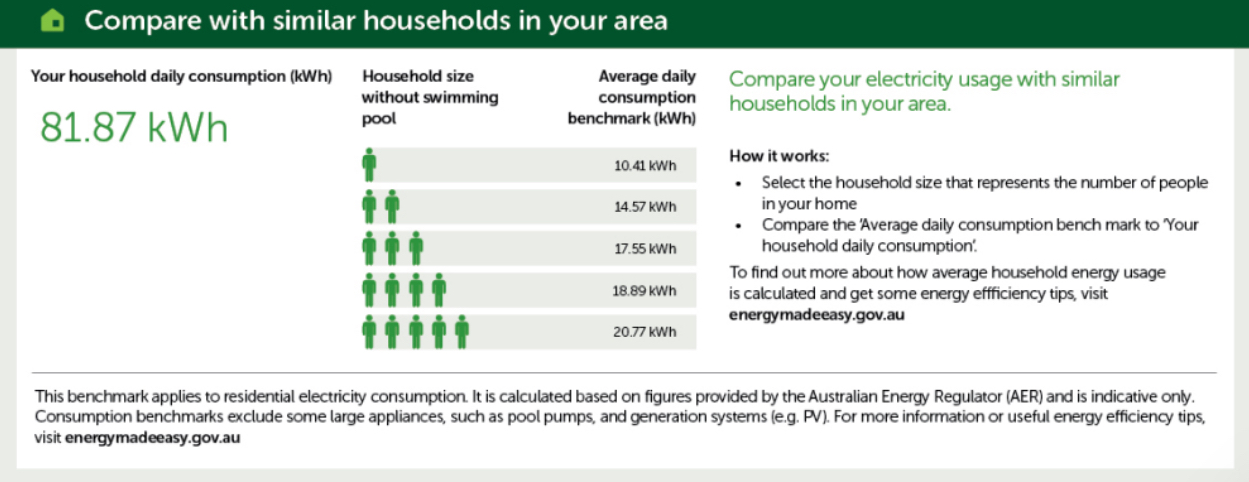
Finally, households may be nudged to be more electricity conscious through standardised usage information. The presentation of information in standarised ways on electricity bills aids consumers to easily interpret key pieces of information about their usage compared to other households. Figure 4 is an example of standardised information presented on Australian electricity bills. This information acts as a nudge as if does not affect price incentives, and is cheap and easy to ignore.
Source: Energy Australia (2025)
Figure 4: Presentation of energy use information to nudge increased efficiency use.
The organisation of electricity systems offers a wide range of configurations. Choice may be centrally controlled or delegated to households. Intervention is used to ensure regular and reliable electricity availability. Additional levels of government intervention may be applied to limit or enhance price information flows to households: price ceilings and subsidies. Change in electricity systems is acute at present. Transitions to more sustainable energy production is causing the costs of electricity production and distribution to rise. How best to manage this transition is a source of critical interest globally. Interdependence is evident between government and private infrastructure investment, production costs and efficiency, and retail prices.
References
Energy Australia (2025). Bill guides: electricity. www.energyaustralia.com.au/home/bills-and-accounts/understand-your-bill/bill-guides (Accessed: 16 November 2025).